
Why Ports & Terminals Need to Ditch Pincodes
Today, if you walk into a major European seaport, you are sure to see the investment in port security solutions everywhere: from fences, to cameras, to smart gates and patrols. All of this is designed to keep cargo safe. However, with 112,420 documented criminal incidents across in 24 months 116 countries between 2024-2025, cargo fraud continues to present a significant challenge. Additionally, cargo theft losses in Europe reportedly jumped by a whopping 400% in 2023 in comparison to 2022.
A Frequent Target
Ports in Europe particularly have proven to be a frequent target of drug networks. For instance, 53kg of cocaine estimated to be worth €20 million was found in September 2026 at the Italian port of Livorno. The drugs were hidden in a container with a banana shipment. This is not an isolated case, in May 2026, 1.5 tons of crystal meth (worth €28.5 million) was found in the Port of Hamburg. The drugs were hidden in sacks that were supposed to contain rice. There are many such cases across Europe with ports of Antwerp and Rotterdam being key targets for drug networks.
A part of this security challenge lies in the container release process. In most ports today, this process still relies on unencrypted pincodes. Criminal networks usually exploit these digital blind spots through intercepted pincodes to execute unauthorized pickups, steal high-value cargo, or retrieve illegal drugs.
Highlighting this vulnerability Nico Wauters, CEO of T-Mining, says: "It’s the equivalent of putting a vault door on the warehouse and leaving the key under the doormat."
Did you know: Europol identifies pincodes as a primary vector for European drug cartels. View our map tracking Drug Incidents across Europe here:
Security Risks of Using Pincodes
When a pincode is issued, it passes sequentially from carrier to forwarder, haulier, and driver. Because various players in the logistics chain frequently use subcontractors, the code passes through up to eight organizations. On top of that, within each organization, teams rely on shared email inboxes to handle absences and distribute tasks. Each email or message sent leaves the static pincode under 'Sent Items'. This essentially creates multiple copies rather than a secure transfer and leaves dozens of people with access to the code.
If a criminal network is aware of the container number and the pincode to release it, it becomes rather easy for their gang to pick-up these containers from the ports.
Additionally, current pincode-dependent release procedures create severe physical security threats for frontline personnel. Drug cartels actively attempt to bribe or intimidate port staff, dispatchers, and truck drivers through threats and violent pressure to gain unauthorized access to containers.
Hence, transitioning away from unencrypted codes is essential to prevent container fraud in maritime logistics.
No more Pincodes
Rather than relying on data copying, Secure Container Release (SCR) replaces pincodes with unique digital tokens. How does this work? Just like a relay baton, the secure token (or the digital right to collect a container) can only be held by one party at a time.
Removing staff access to unencrypted pincodes eliminates the pressure to target workers. With Secure Container Release (SCR), T-Mining aims to do just that. In a 2025 article by Trends magazine, Tom De Jong, Process Manager at Hapag-Lloyd, noted: “The safety of our own personnel is our top priority, and thanks to T-Mining's technology, our main security issue has been resolved.”
By utilizing a distributed ledger system based container tracking framework, every transfer of collection rights is recorded and verified, creating an immutable, tamper-proof chain of custody.
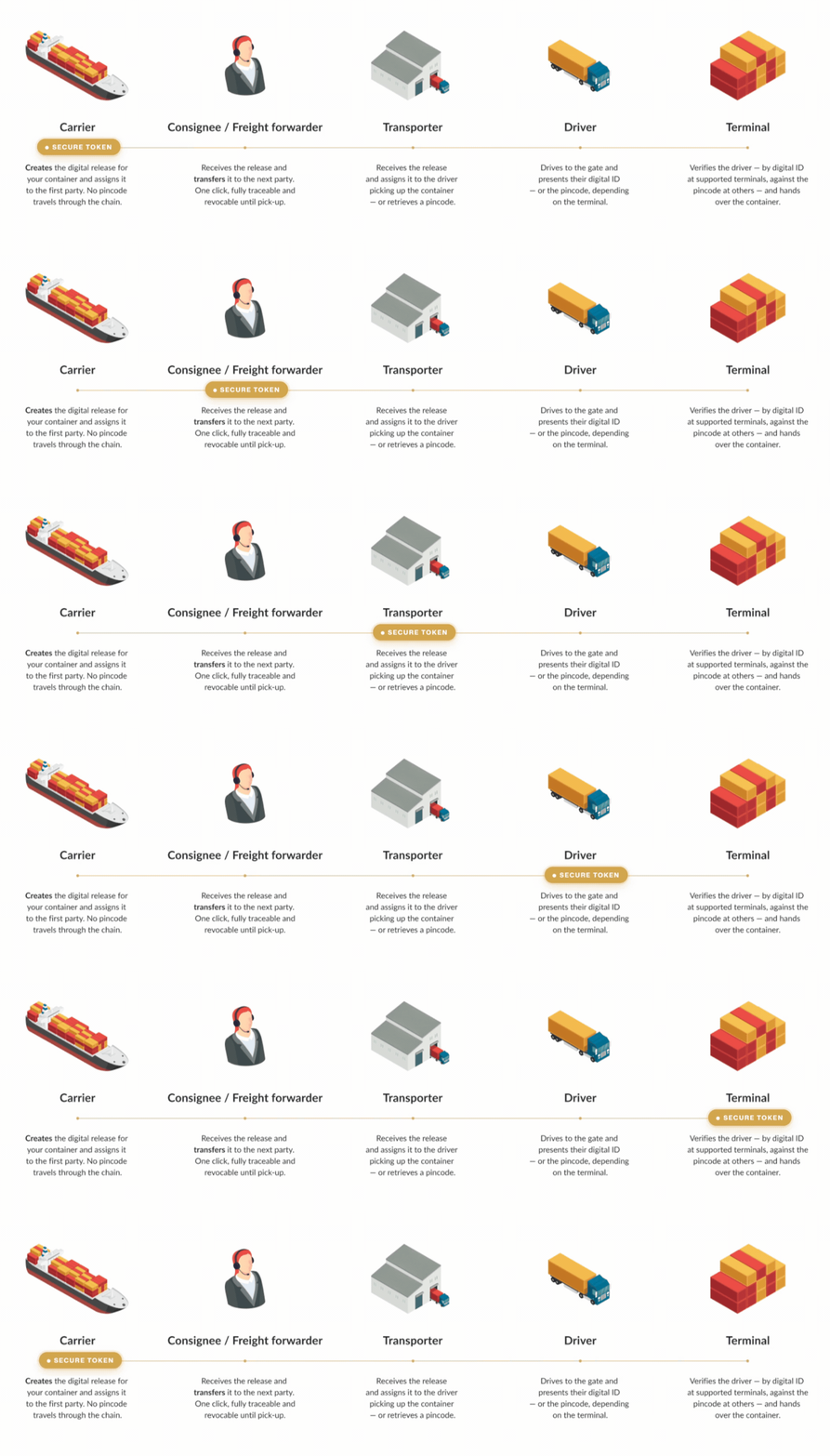
Security is further enforced through the Trust Layer within SCR. The Trust Layer within SCR includes a network of verified parties. The digital identity of every person and company within the platform has been checked via mechanisms such as digital identity verification platforms like itsme®. Additionally, platforms like Alfapass at terminal gates ensures that only authenticated drivers can collect assigned cargo, maintaining strict physical accountability. On top of this suppliers and customers acknowledge each other through mutually approved digital handshakes before any transaction takes place. Additionally, when the release of the container is passed on from one party to another, it is done without any ‘copies’ being made, i.e. only one party has the exclusive right to pick-up a container at one point in time. With the use of cryptographic ID Wallets every action that is taken in the process of container release is traceable and available via a single shared record that cannot be altered by anyone.
SCR is now present across 25 countries in Europe and is used by large carriers including MSC, and Hapag-Lloyd.
Adopting a pincode free container pickup is an essential operational requirement for modern ports. By unifying ocean carriers, ports, and logistics providers around interoperable digital tokens, the maritime industry can permanently eliminate legacy access vulnerabilities, protect port workers, and secure global supply chains.
Curious about SCR for your port or terminal? Contact us to understand how SCR can secure your release process.